Casting is an indispensable process in the manufacturing industry. With the continuous advancement of modern manufacturing processes and product design, product complexity and precision are increasing, making product quality inspection increasingly difficult. Traditional inspection methods and surveying tools are no longer able to meet market demand.
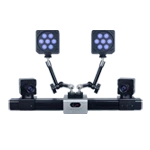
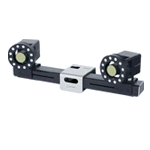
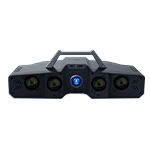
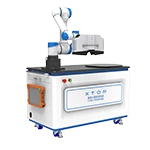
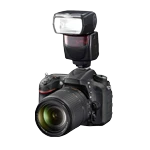
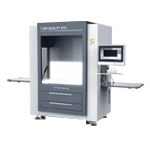
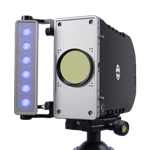
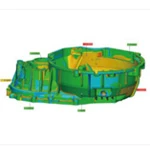
Inspection of large forgings and castings is often performed on-site, which is challenging due to factors such as poor on-site conditions and difficulty in merging workpiece data. The XTDP 3D optical photogrammetry system combined with the XTOM high-precision 3D scanner is used to measure key dimensions of large forgings and castings, determine machining allowances and partial machining dimensions, and perform full-scale measurements of the product.
Advantages of 3D photogrammetry combined with blue light 3D scanning:
1. Portable photogrammetry can obtain the overall coordinates of large parts, facilitating workshop work.
2. Blue light 3D scanning is unaffected by natural lighting and workpiece surface conditions.
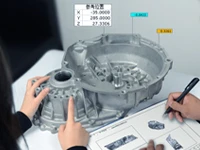
3. Traditional measurement methods struggle to inspect curved surfaces, angles, and certain geometric tolerances. 3D scanning, however, can inspect all structural dimensions and geometric tolerances.
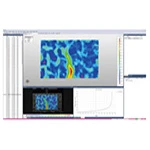
4. Software analysis and automatic reporting of inspection results eliminate errors that can occur during manual measurement and transcription. Compared to traditional inspection methods, 3D scanning technology offers high accuracy, speed, portability, real-time visualization, automatic mesh output, and non-contact measurement. It offers unique advantages for measuring complex objects with numerous irregularly shaped surfaces.
In the foundry industry, 3D photogrammetry combined with 3D scanning technology can be applied to reverse design, product improvement, mold inspection, and product testing during the casting process of large forgings and castings, significantly facilitating product development, production, and inspection.